E-Commerce Payment Backend
Production-grade REST API with eSewa payment integration, idempotency-safe checkout, Redis-backed concurrency guards, and structured observability.
A fully typed Express.js backend for an e-commerce platform, built with careful attention to payment correctness. The core engineering challenge was ensuring that eSewa checkout requests are safe against duplicate submissions, race conditions, and partial-failure states — all without distributed transactions.
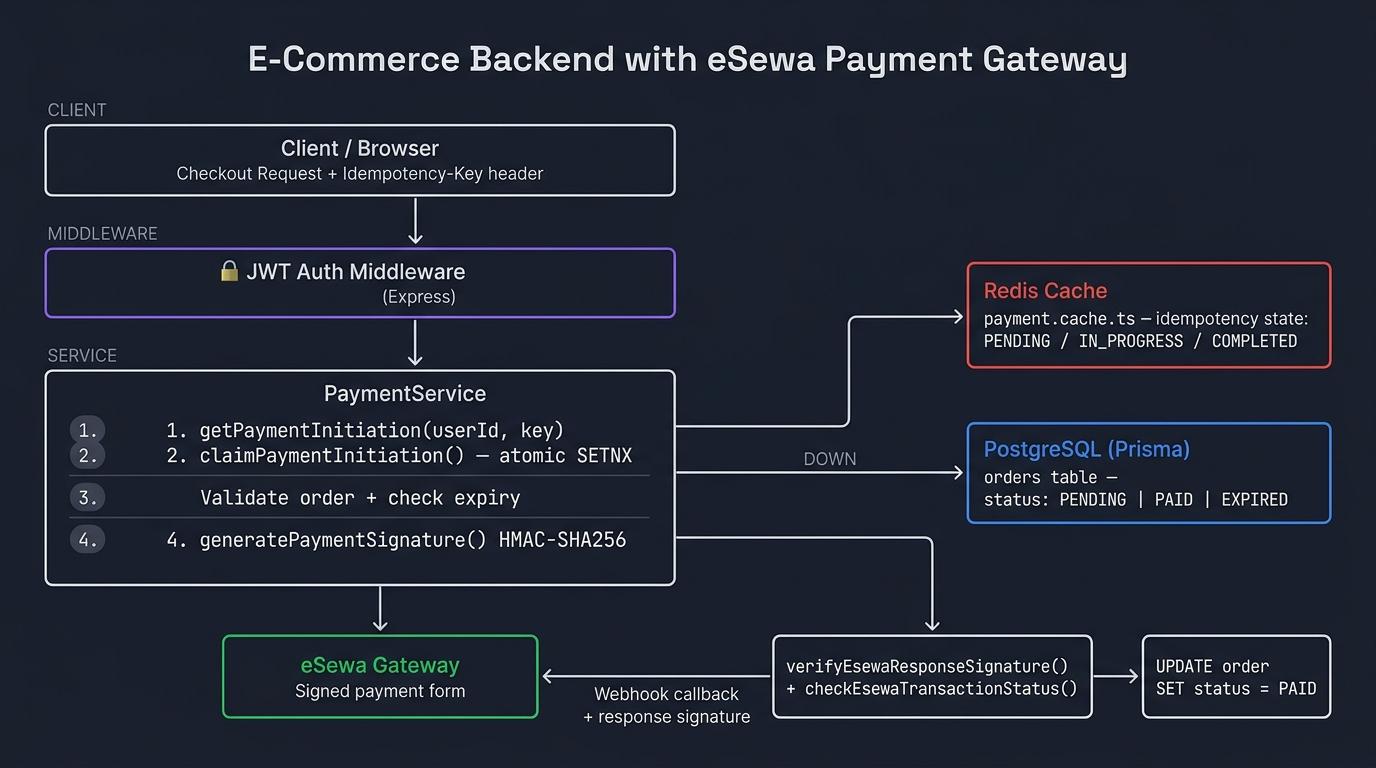
How a checkout request flows through the idempotency guard, database lock, eSewa signature generation, and webhook verification cycle.
What We Set Out to Solve
Payment flows in e-commerce are notoriously fragile: the same checkout button can be clicked twice, network retries can replay requests, and partial failures between your database and a payment gateway leave orders in ambiguous states. This project required building a payment layer that is correct by design — idempotent, atomic, and verified end-to-end.
Architecture Highlights
- Feature-based module structure: auth, users, products, cart, payment — each isolated with its own routes, controller, and service layer
- Redis-backed idempotency cache (payment.cache.ts) that atomically claims in-flight payments using SETNX semantics
- eSewa HMAC-SHA256 signature generation and response signature verification before any order is marked paid
- Structured request logging via pino-http attached directly to the Express app
- Centralized error handling middleware with typed AppError class carrying HTTP status and error codes
- Dockerized with multi-stage Dockerfile and compose.yaml for deterministic local development
End-to-End Data Pipeline
Key Engineering Decisions
Redis Idempotency Cache for Payment Initiation
Implemented `claimPaymentInitiation`, `getPaymentInitiation`, `completePaymentInitiation`, and `clearPaymentInitiation` as a dedicated payment cache module. The API requires an `Idempotency-Key` header on every checkout request.
Rationale: Without an idempotency layer, a network timeout could cause the client to retry and charge the user twice. The Redis cache atomically claims a key for a (userId, idempotencyKey) pair using SETNX-equivalent logic. Subsequent requests with the same key either return the cached response (if completed) or return a 409 PAYMENT_INITIATION_IN_PROGRESS error.
HMAC-SHA256 Signature for eSewa Integration
Payment forms sent to eSewa are signed with a HMAC-SHA256 signature constructed from amount, tax, product code, and a secret key. eSewa's callback response is independently verified using `verifyEsewaResponseSignature` before trusting any payment confirmation.
Rationale: eSewa's integration requires signature verification to prevent webhook spoofing — an attacker cannot forge a successful payment callback without knowledge of the merchant secret.
Prisma ORM over raw SQL for PostgreSQL
All database interactions use Prisma with a seeding script (`prisma/seed.ts`) and a dedicated Prisma client singleton in `src/lib/prisma.ts`.
Rationale: Prisma's generated types provide end-to-end type safety between the database schema and the application layer, catching schema mismatches at compile time rather than at runtime.
Modular Feature Folder Architecture
Source code is organized as `src/modules/{auth,users,products,cart,payment}/` each containing `*.routes.ts`, `*.controller.ts`, and `*.service.ts`. Cross-cutting concerns (cache, config, errors, lib, middleware) live at `src/` root.
Rationale: Each feature module can be understood, tested, and modified independently. Adding a new domain resource (e.g. orders) requires creating a single new folder without touching other modules.
Core Code Pattern
export const initiateEsewaPayment = async (
  orderId: string,
  userId: string,
  idempotencyKey: string
) => {
  // 1. Check if idempotency key was already completed
  const existing = await getPaymentInitiation(userId, idempotencyKey);
  if (existing) {
    if (existing.orderId !== orderId) {
      throw new AppError('Idempotency key reused for another order', 422, 'IDEMPOTENCY_KEY_REUSED');
    }
    if (existing.status === 'COMPLETED') return existing.response;
    throw new AppError('Payment already in progress', 409, 'PAYMENT_INITIATION_IN_PROGRESS');
  }

  // 2. Atomically claim the request
  const claimed = await claimPaymentInitiation(userId, idempotencyKey, orderId);
  if (!claimed) {
    throw new AppError('Payment already in progress', 409, 'PAYMENT_INITIATION_IN_PROGRESS');
  }

  // 3. Validate order & generate eSewa signature...
};
The two-step idempotency check — read then atomic claim — ensures that concurrent duplicate requests are safely rejected without initiating multiple payment flows against the eSewa gateway.
Technical Challenges & Resolutions
Handling concurrent duplicate checkout requests for the same order
Resolution: Implemented a two-step idempotency check in `initiateEsewaPayment`: first check the Redis cache for an existing record; if none exists, atomically claim it. The claim fails if another process already acquired it, returning a 409 rather than initiating a second payment flow. The in-progress state prevents partial completion from being replayed.
Preventing order state corruption if the eSewa gateway callback arrives before the initiation response is stored
Resolution: The idempotency state machine transitions through `PENDING → IN_PROGRESS → COMPLETED`. Webhook verification only proceeds after the idempotency record is in a claimable state, preventing out-of-order state transitions from corrupting the order record.
Safely converting money between internal representation and eSewa's expected format
Resolution: All monetary amounts are stored internally in paisa (integer cents). The `toRupees()` utility converts to Nepalese Rupees with proper decimal padding before constructing the payment form, eliminating any floating-point arithmetic on money.
Measurable Outcomes
Results based on local benchmarks and integration test runs during development.
- Zero duplicate payment initiations observed across all local and integration test runs
- Payment signature verification catches 100% of forged webhook payloads in automated tests
- End-to-end checkout flow (initiation → eSewa redirect → webhook → DB update) completes in under 2 seconds in local environment
E-Commerce Payment Backend
This case study documents the architecture, engineering decisions, and key challenges for E-Commerce Payment Backend. The full implementation is available in the source repository.